 DeFi Market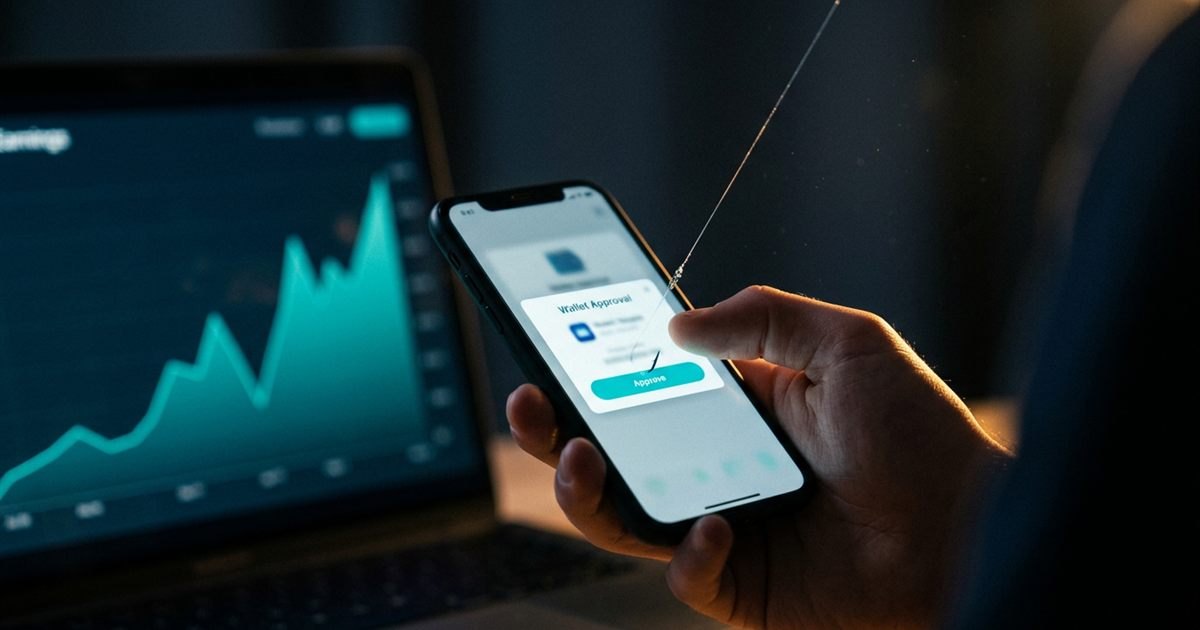
No. Nobody mines USDT. Tether issues it, and no wallet, app or "pool" can make more of it by holding it. A "wallet mining" invite is a trick to get you to press one button that signs a token approval. That approval lets the scammer's contract take your USDT whenever it wants. The FBI warned about this exact scheme, which it calls liquidity mining, back in 2022. If you already pressed the button, revoke the approval today and don't pay any "withdrawal fee".
What is crypto wallet mining?
It usually starts with a message. A friendly stranger on Telegram, WhatsApp or a dating app. The pitch: keep USDT in your own wallet, press "Join" or "Receive voucher" on their site, and earn a daily reward just for holding it. You never send them a cent, they say. The money stays in your wallet.
That last line is the hook, and it's half true. The money does stay in your wallet. For now.
The FBI's July 2022 public service announcement laid the whole thing out. Victims were promised 1% to 3% a day, told to buy USDT or ETH, and sent to a fake "liquidity mining" app to collect a mining certificate, voucher or node. The FBI counted more than $70 million in losses from this one scheme between January 2019 and mid-2022. Four years on, the same pitch still circulates under new names: wallet mining, USDT mining, node rewards, staking vouchers.
How the "Join" button drains your wallet
USDT on Ethereum, Tron and most other chains is a token that follows a standard. On Ethereum it's called ERC-20, and it includes a function called approve. You use it to let a contract spend your tokens for you. Swap sites use it constantly, which is why people stop reading approval pop-ups.
When you press "Join" on a wallet mining site, your wallet pops up a request. Signing it gives the scammer's address permission to move your USDT, often an unlimited amount, with no further signature from you. The FBI described the result plainly: the scammers can pull funds from the wallet without the owner being notified.
So they don't need your seed phrase, and you never send them anything. They just wait.
Why the earnings look real
The site shows a dashboard. Your balance, your "mining level", a reward counter that climbs every few hours. Some send a small real payout early on, so you believe it works.
None of that is mining. The operator types those numbers into a web page. The FBI's PSA said victims saw falsified returns, and that's what kept them adding money. The usual next step is a tier chart: hold 5,000 USDT and your daily rate goes up. People move savings in to reach the next level. All of it sits under the approval they already signed.
Do the arithmetic on the promise. At 1% a day, compounded, $1,000 would be about $37,800 after one year. (Our math, on the low end of the promise.) No real yield in finance pays like that, and anyone who had it wouldn't need strangers on Telegram.
| Real liquidity providing | "Wallet mining" invite | |
|---|---|---|
| What you do | Deposit two tokens into a trading pool | Press "Join" while holding USDT |
| Where the yield comes from | Trading fees paid by swappers | Nowhere. The dashboard is made up |
| Typical return | Varies with volume, can lose money | A fixed 1% to 3% a day |
| Withdrawing | Any time, minus network gas | Blocked until you pay a "fee" |
| How you found it | You went looking | A stranger messaged you |
Why withdrawals need a "fee"
Sooner or later one of two things happens. Your wallet empties overnight, or you try to cash out the dashboard balance and get told you can't yet. There's a withdrawal fee, an anti-money-laundering deposit, a tax, a "verification" payment. Pay it and there's another one.
This is the same ending the FBI describes across crypto investment fraud generally. Its 2025 Internet Crime Report says victims who try to withdraw get charged taxes and fees as a final squeeze before the scammers disappear. Crypto investment fraud cost Americans $7.2 billion in 2025, from 61,559 complaints. In the 2022 liquidity mining cases, fake customer service told victims to deposit more to recover their funds.
⚠ Red flag
A real platform takes its fee out of your balance. If anyone asks you to send new money before you can withdraw old money, the old money is already gone. Don't pay. And ignore anyone who contacts you afterward offering to recover it for a fee. That's the next scam.
Prefer to watch? What that "Join" button really does, in 51 seconds.
How to check and revoke token approvals
If you pressed the button, the approval is probably still live, even if your wallet hasn't been touched yet. Scammers sometimes wait for a bigger balance. Revoke it before you put another dollar in that wallet.
- Find your approvals. For USDT on Ethereum, put your wallet address into Etherscan's Token Approvals page. For USDT on Tron, Tronscan shows approvals on your account page.
- Look for anything you don't recognize. Pay attention to approvals marked "unlimited" and to any spender you can't match to an app you trust.
- Revoke it. Connect your wallet on that page and press Revoke. It's a normal transaction, so it costs a small network fee in ETH or TRX.
- If the approval was unlimited and you're unsure, move what's left. Send your remaining funds to a fresh wallet you control. Never type your seed phrase into any site that asks for it during this.
Revoking works. During Operation Spincaster, investigators warned one victim in time and the scammer's approval was revoked before six figures disappeared, according to Chainalysis. The firm also reports that Operation Atlantic, led by the UK's National Crime Agency with the US Secret Service and Ontario police in March 2026, identified more than 20,000 victims of approval scams and froze more than $12 million.

Rob's take
I bought my first Bitcoin in 2011 and I've never seen honest money pay 1% a day. What bothers me about this one is how it borrows real words. Liquidity mining was a real thing in DeFi. Approvals are a real thing. The scam works because it sounds like the stuff you half-remember reading about. If you can't say where the yield comes from in one sentence, walk away.
Where to report a wallet mining scam
- The FBI at ic3.gov. Include the site address, the wallet addresses involved, transaction IDs and screenshots of the chats. The FBI's PSA asks for exactly this.
- The FTC at ReportFraud.ftc.gov.
- The exchange you bought the USDT on. Give them the scammer's wallet address. Exchanges and Tether can freeze USDT that's still sitting in a flagged address, so speed matters.
If you keep stablecoins, read stablecoins explained to see where USDT really comes from, hot wallet vs cold wallet for where to hold it, and how to spot a rug pull before you connect a wallet to anything new.